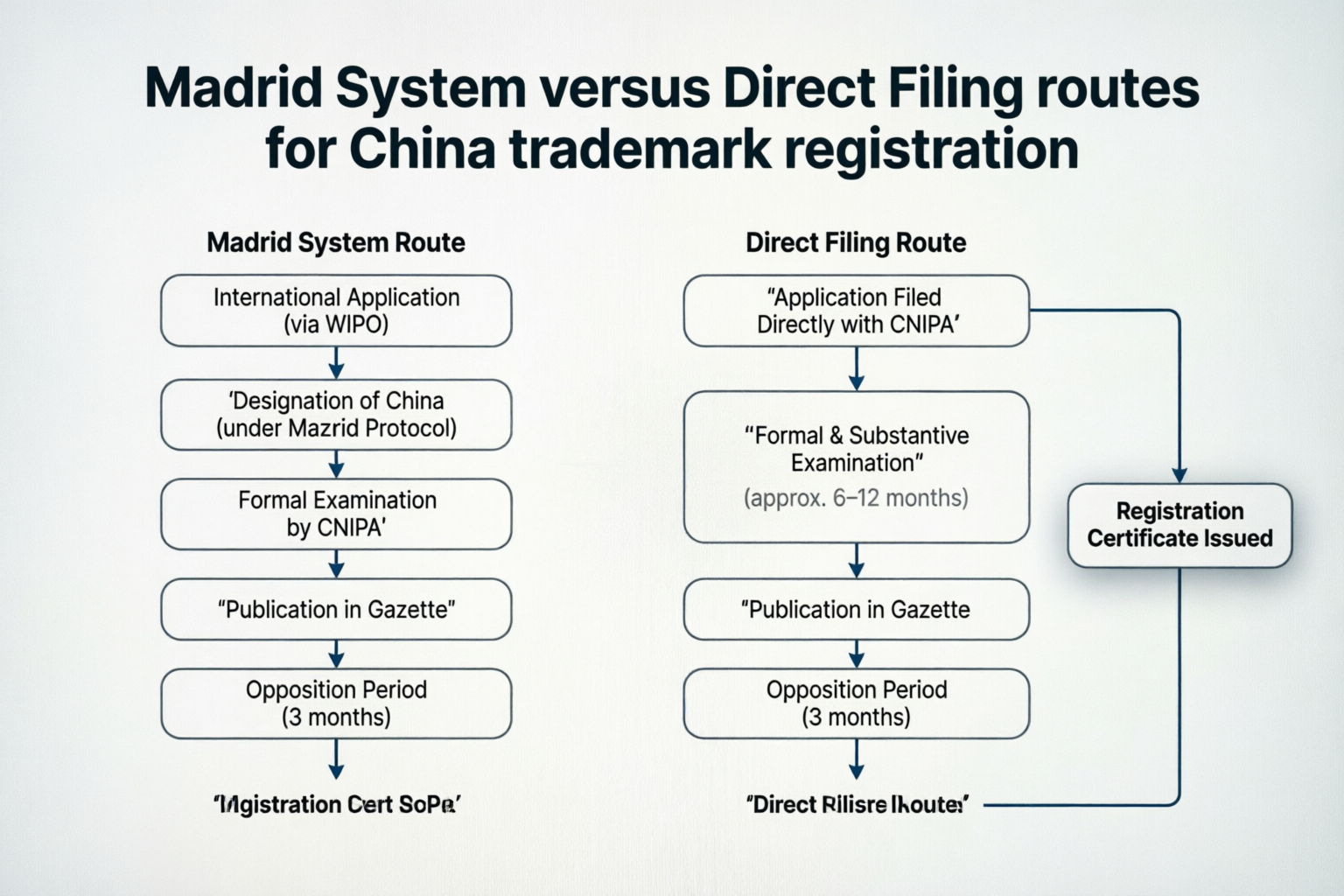
Foreign applicants have two distinct routes to register a trademark in China: filing directly with CNIPA through a local agent, or designating China through the Madrid Protocol. Each path has its own costs, timelines, and strategic trade-offs. This guide compares both so you can choose the right approach.
Route 1: Direct CNIPA Filing
File directly with the China National Intellectual Property Administration through a CNIPA-accredited agent.
Advantages
- Independent examination: Your China application is examined on its own merits, unaffected by issues in your home country registration
- Faster timeline: Typically 12–18 months from filing to registration, versus 18+ months via Madrid
- Broader goods/services: You can use CNIPA-specific subclass descriptions that are not available through Madrid
- Direct certificate: You receive a standalone CNIPA registration certificate
- Full control: Amendments, assignments, and renewals are handled directly with CNIPA
Disadvantages
- Requires a local agent (mandatory for foreign applicants)
- Higher upfront cost per country if filing in multiple jurisdictions
- Separate filing required for each country
Route 2: Madrid Protocol Designation
File an international application through WIPO, designating China as one of the target countries.
Advantages
- One application, many countries: A single filing can cover multiple Madrid member states
- Lower agent fees: No need for a separate local agent in each country for the initial filing
- Simplified management: Renewals, assignments, and name/address changes can be processed centrally through WIPO
- Cost-effective for multi-country portfolios: Particularly efficient when filing in 5+ countries
Disadvantages
- Central attack vulnerability: For the first 5 years, if your home country registration is cancelled, all Madrid designations collapse
- Slower CNIPA examination: Madrid designations can take 18+ months for CNIPA to examine
- Limited to Nice Classification: You cannot take advantage of CNIPA-specific subclass descriptions
- No standalone certificate: CNIPA issues only a Statement of Grant of Protection, not a standard registration certificate
Cost Comparison: Direct Filing vs. Madrid
| Cost Component | Direct CNIPA Filing | Madrid Designation |
|---|---|---|
| CNIPA official fees | RMB 270/class (electronic) | Included in WIPO international fees |
| WIPO international fee | — | CHF 653 (basic) + CHF 100 per class + China designation fee |
| Local agent fees | RMB 3,000–8,000/class | RMB 1,500–4,000 for handling the designation |
| Translation | Included in agent fee | Handled through your home agent/WIPO |
For a single-country filing, direct registration is usually cheaper and faster. Madrid becomes attractive when you designate several countries in one application, because WIPO fees are shared across the entire portfolio.
Step-by-Step: Direct CNIPA Filing
- Engage a CNIPA-accredited agent and complete a power of attorney.
- Provide your mark (word, logo, or combined) and a precise list of goods/services.
- The agent runs a clearance search and recommends classes and specifications.
- File the application electronically; CNIPA issues a filing receipt.
- Formal examination takes about 1–2 months, followed by substantive examination.
- If approved, the mark is published for a 3-month opposition period.
- A registration certificate is issued; the term runs 10 years from registration.
Decision Matrix
| Scenario | Recommended Route |
|---|---|
| China is your only or primary market | Direct CNIPA filing |
| Filing in 5+ countries simultaneously | Madrid Protocol |
| Need specific CNIPA subclass protection | Direct CNIPA filing |
| Budget-conscious with a simple mark | Madrid Protocol |
| Complex or risky mark needing strategic handling | Direct CNIPA filing |
| Home country registration is stable and >5 years old | Madrid Protocol |
Step-by-Step: Madrid Designation of China
- Ensure you hold a basic registration or pending application in your home country.
- File an international application with WIPO, directly or through your home IP office.
- Designate China in the application and pay the relevant designation fee.
- WIPO examines formalities and forwards the application to CNIPA.
- CNIPA examines within roughly 12–18 months and issues a Statement of Grant of Protection.
- Monitor the protection in China and file oppositions if third parties challenge it.
Related Articles
- Madrid System for China: International Trademark Registration
- Paris Convention Priority for China Trademark Filings
- Complete Guide to China Trademark Registration Process
Official Resources
Disclaimer: This article provides general information and does not constitute legal advice. Trademark strategy should be tailored to your specific business circumstances.