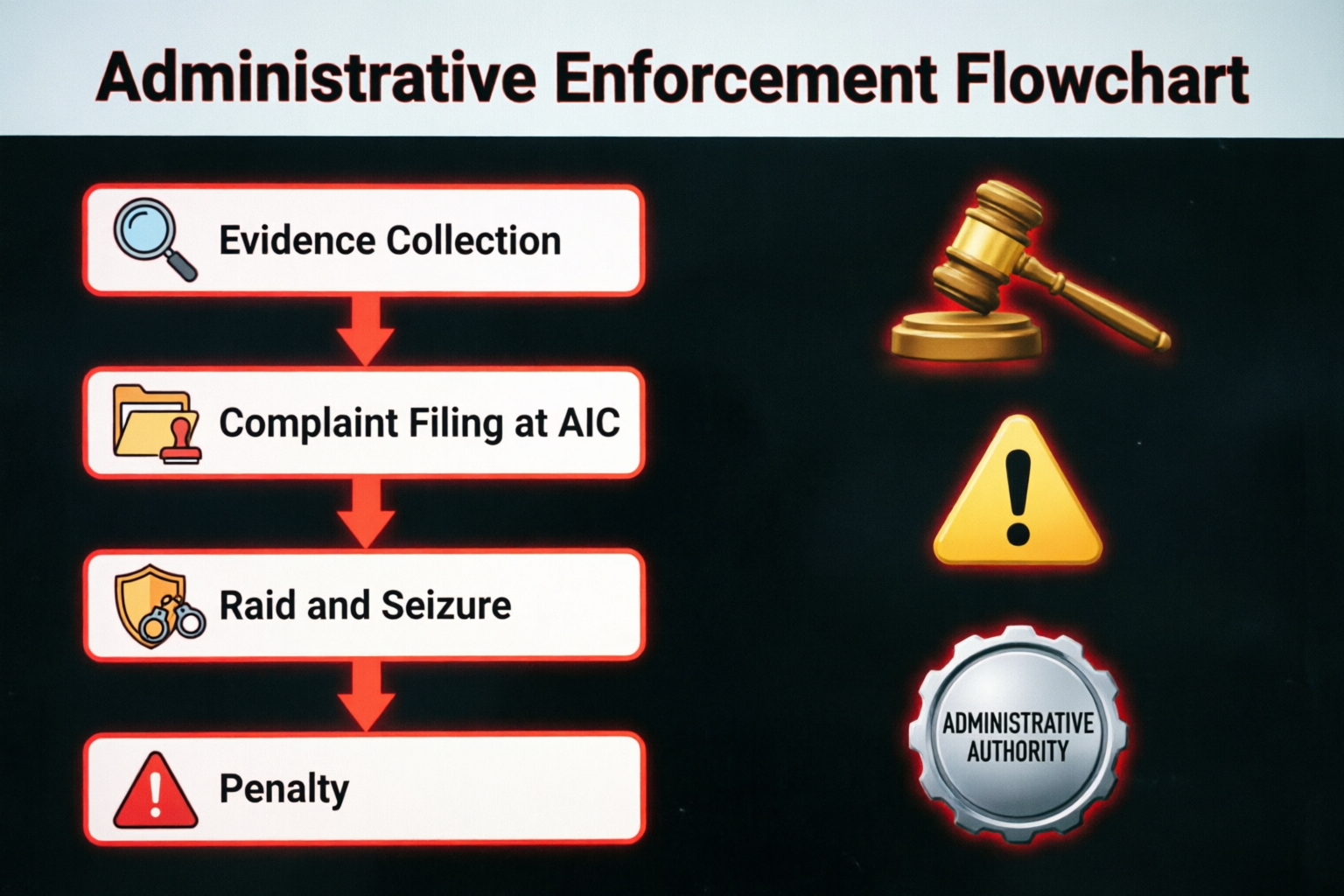
Administrative enforcement is the most common route for tackling counterfeits in China—faster, cheaper, and often more effective than litigation. This guide explains how to file administrative complaints with local market supervision bureaus (MSBs) and what to expect at every stage of the process.
Why Administrative Enforcement?
For most trademark owners, administrative enforcement offers the fastest path from complaint to action. Unlike civil litigation, which can take 12–18 months, administrative raids can occur within days, and most cases resolve within 1–3 months.
- Speed: Raids can happen within days of filing a complaint
- Low cost: No court fees; only agent and evidence preparation costs
- Effective remedies: Seizure, destruction, fines, and business license revocation
- Deterrent effect: Administrative penalties create a public record that discourages repeat offenders
How to File an Administrative Complaint
File with the local Administration for Market Regulation (AMR) where the infringer is located or where the infringement occurs. A complete complaint package dramatically improves the speed and success of enforcement.
Required Documents
Prepare the following before filing: your trademark registration certificate (with certified Chinese translation), a Power of Attorney, evidence of infringement such as notarized purchase receipts and photographs, and a detailed complaint letter written in Chinese describing the infringement and the relief requested.
Choosing the Right AMR Office
Select the AMR with jurisdiction over the infringer’s business premises or the location where the counterfeit goods are manufactured, stored, or sold. Filing in the wrong jurisdiction can cause delays while the case is transferred.
The Enforcement Timeline
| Stage | Typical Duration |
|---|---|
| Complaint acceptance and review | 7–15 days |
| Raid and evidence seizure | Within days to weeks of acceptance |
| Investigation and penalty decision | 1–3 months |
| Appeals or complex cases | Up to 6 months |
What Evidence Do You Need?
The strength of your evidence largely determines whether the AMR will act. Gather evidence that establishes both your rights and the infringement itself.
Evidence of Your Rights
Submit your valid trademark registration certificate and proof of identity of the rights holder. For foreign applicants, a certified translation and a notarized Power of Attorney are normally required.
Evidence of Infringement
- Notarized purchase of counterfeit products
- Photos of the infringing goods and storefront
- Comparison chart showing genuine vs. counterfeit products
- Any prior warning letters or communications with the infringer
Strengthening Your Evidence
Notarization is critical—unnotarized evidence can be challenged and excluded. Work with a local agent to conduct notarized test purchases and to document the infringing premises, storage locations, and sales channels before filing.
What Remedies Can You Expect?
A successful administrative action can deliver a range of remedies that protect your brand and punish the infringer. Common outcomes include seizure and destruction of counterfeit goods, fines calculated as a multiple of illegal turnover, and, in serious cases, revocation of the infringer’s business license.
Initiating an Administrative Raid
A raid is the sharpest tool in the administrative toolkit: AMR officers enter the premises, seize infringing goods and equipment, interview the operator, and prepare an official record — typically completing the on-site work in a few hours.
To initiate one, file your complaint with the AMR office in the jurisdiction where the infringement is occurring, and provide your Chinese registration certificate, notarized evidence (test purchases, photographs of the goods and premises), and the specific address of the infringing activity. Expect a decision on whether to act within roughly one to four weeks; in urgent cases a raid can happen within days. Having a representative present to distinguish genuine from counterfeit goods is strongly recommended.
After the raid, the AMR issues an administrative penalty decision — fines, confiscation, and a cease-and-desist order. That decision can then anchor a follow-on civil suit for damages, since the raid itself does not award compensation to the rights holder.
Common Challenges and How to Overcome Them
Administrative enforcement is powerful but not automatic. Local market supervision bureaus vary in their responsiveness, and cases with weak or incomplete evidence are sometimes declined for administrative handling. You can improve your odds by presenting a complete, notarized evidence package, filing in the correct jurisdiction, and working through a local agent who understands the relevant office’s internal procedures and evidentiary expectations.
- Weak evidence: Invest in notarization and professional documentation before filing
- Wrong jurisdiction: Confirm the correct AMR office to avoid case-transfer delays
- Slow response: Escalate to a higher-level bureau when a local office is unresponsive
- Recurring infringement: Combine raids with online takedowns and customs recordal
If an AMR declines to act, you still have options. You can escalate the complaint to a higher-level market supervision bureau, or shift to civil litigation or criminal enforcement for serious counterfeiting. Layering administrative pressure with online platform takedowns and customs recordal creates a strategy that is harder for infringers to ignore and produces faster, more durable results.
Related Articles
- Trademark Infringement Enforcement Options
- China Customs Trademark Recordal
- E-Commerce Brand Protection
Official Resources
Disclaimer: Enforcement strategies depend on specific situations. Consult a qualified IP professional.