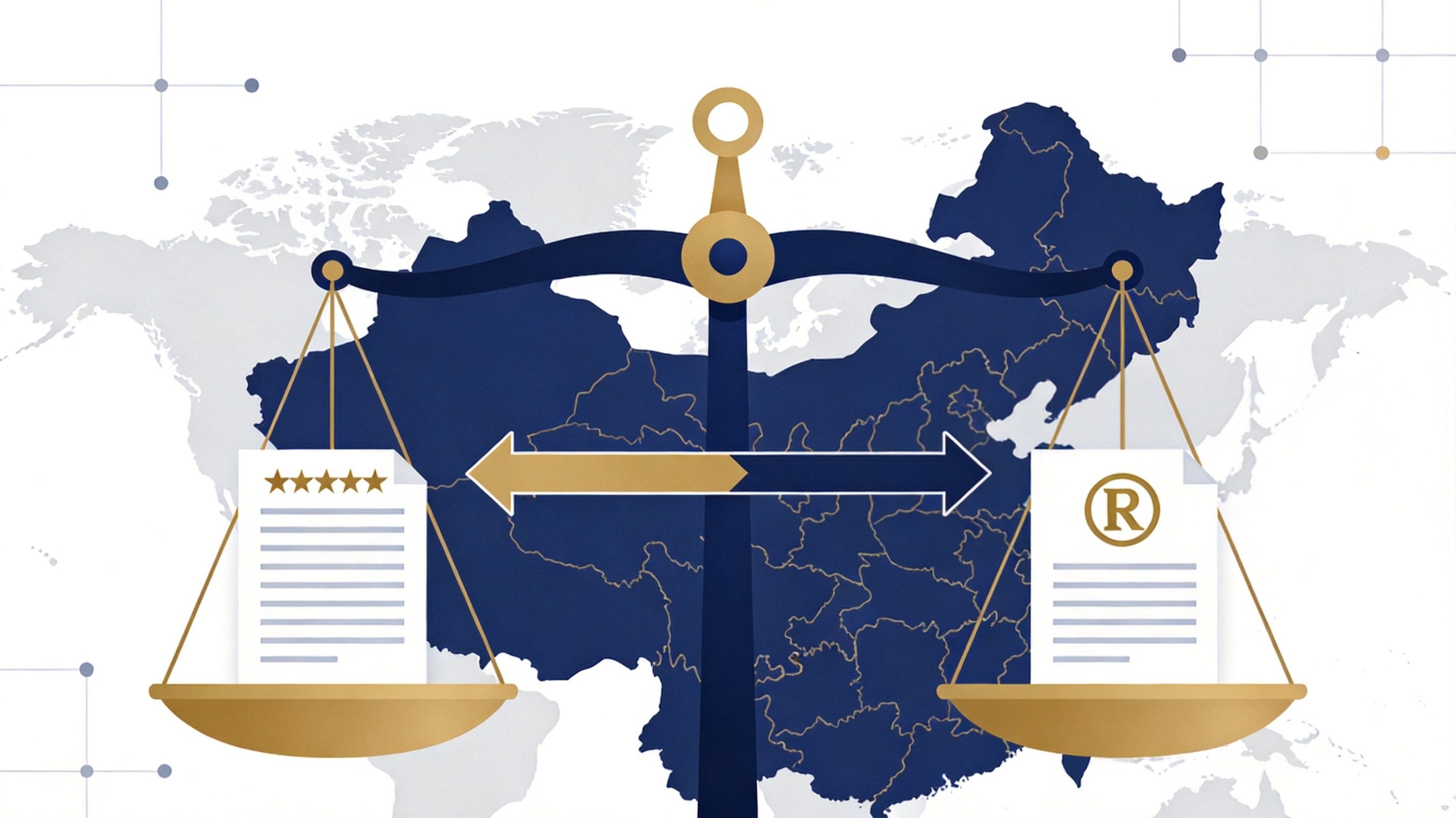
European companies entering the Chinese market face a fundamentally different trademark landscape. The EU Intellectual Property Office (EUIPO) and China’s CNIPA operate under distinct legal frameworks, examination standards, and enforcement mechanisms. Understanding these differences is essential for protecting your brand across both jurisdictions.
Key Differences: EUIPO vs. CNIPA
| Factor | EUIPO (EU) | CNIPA (China) |
|---|---|---|
| Legal Basis | First-to-use + first-to-file hybrid | Strict first-to-file |
| Examination | Limited examination of relative grounds | Full examination of both absolute and relative grounds |
| Opposition Period | 3 months after publication | 3 months after preliminary approval |
| Non-Use Grace Period | 5 years from registration | 3 years from registration |
| Subclass System | No subclass system | Detailed subclass system within each Nice class |
| Office Actions | Usually limited to formality issues | Substantive refusals on distinctiveness, similarity, and descriptiveness |
| Use Requirement | Genuine use in the EU required | Use in China required; foreign use does not count |
Strategic Implications for EU Brands
1. File Early, File First
The first-to-file system means EU companies must file in China before entering the market, not after. A European trademark registration provides no protection in China. Even if you have been using the mark in Europe for decades, a third party can register it in China before you.
2. Trademark Squatting Is a Real Risk
EU brands are frequent targets of trademark squatters in China. Well-known examples include New Balance (forced to pay millions to recover its Chinese name), Apple (iPad trademark dispute), and Tesla (Chinese trademark dispute). The best defense is early registration.
3. Chinese Language Marks Are Essential
Unlike in the EU, where a single mark in any EU language covers all member states, China requires separate consideration for Chinese-language marks. Your EU trademark registration in English or your national language does not protect the Chinese transliteration. File a Chinese-language version separately.
4. Goods/Services Descriptions Must Be Specific
EUIPO accepts broad class headings and general descriptions. CNIPA requires specific, itemized goods and services descriptions that align with China’s subclass system. A description that passes EUIPO examination may be rejected by CNIPA as too vague.
Practical Filing Strategy for EU Companies
Phase 1: Pre-Filing (4-6 weeks before launch)
- Conduct a comprehensive China trademark search, including Chinese character transliterations
- Identify the appropriate Chinese brand name (transliteration, translation, or both)
- Determine the correct classes and subclasses
Phase 2: Filing
- File through Madrid Protocol (based on EU registration) OR direct with CNIPA
- File English mark, Chinese mark, and logo separately
- Consider defensive filings in related classes
Phase 3: Post-Registration
- Record registration with China Customs
- Set up trademark watch for conflicting applications
- Plan for active use in China (required within 3 years to avoid cancellation)
Enforcement: EU vs. China
Enforcement mechanisms differ significantly:
- EU: Relies on civil litigation, customs actions, and EUIPO opposition/cancellation proceedings. Relatively predictable and efficient.
- China: Offers administrative enforcement (through local AMRs), civil litigation, and criminal prosecution. Administrative actions are often faster and less expensive than litigation, making them the preferred first step for many infringement cases.
Get Expert Guidance
Navigating the differences between EU and Chinese trademark systems requires specialized expertise. Our team has extensive experience helping European companies protect their brands in China. Contact us for a consultation on your EU-China trademark strategy.