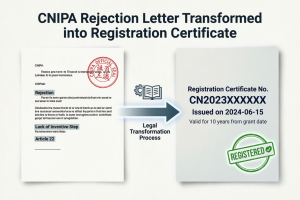
Distinctiveness is the most common ground for CNIPA Office Actions, particularly for foreign brands. Chinese trademark examiners frequently find that marks in foreign languages, descriptive terms, or common phrases lack the distinctiveness required for registration. This article provides a detailed framework for responding to distinctiveness refusals.
Understanding CNIPA’s Distinctiveness Standard
Under Article 11 of the Chinese Trademark Law, the following marks are considered lacking in distinctiveness:
- Marks consisting solely of generic names, designs, or models of the goods
- Marks that directly describe the quality, raw materials, function, use, weight, quantity, or other characteristics of the goods
- Marks that lack other distinctive characteristics
Importantly, even if a mark falls into one of these categories, it may still be registrable if it has acquired distinctiveness through use.
Strategy 1: Argue Inherent Distinctiveness
The most common response to distinctiveness Office Actions is to argue that the mark is inherently distinctive. Key arguments include:
The Mark is Suggestive, Not Descriptive: Suggestive marks require imagination to connect the mark to the goods. A descriptive mark directly tells consumers about the goods. For example, “Greyhound” for buses is suggestive (it suggests speed), while “Fast Bus” would be descriptive.
The Mark is an Arbitrary or Fanciful Term: Arbitrary marks use common words in unrelated contexts (e.g., “Apple” for computers). Fanciful marks are invented words (e.g., “Kodak”). These are inherently distinctive.
Foreign Language Exception: For foreign brands, a powerful argument is that the average Chinese consumer would not understand the descriptive meaning of the foreign-language mark. This is particularly effective for marks in languages other than English, such as French, Italian, or German.
Strategy 2: Prove Acquired Distinctiveness
If the mark is descriptive, you can overcome the Office Actions by proving that consumers now associate the mark with your brand. Evidence should include:
- Duration of use: How long the mark has been used in China
- Sales volume: Revenue data showing commercial success
- Advertising expenditure: Marketing investment in China
- Market share: Evidence of your position in the Chinese market
- Consumer surveys: Independent survey data showing consumer recognition
- Media coverage: Articles and reports about your brand in Chinese media
Strategy 3: Disclaim Descriptive Elements
In some cases, you can overcome Office Actions by disclaiming the descriptive elements of your mark. For example, if your mark is “FreshBake Bakery,” you could disclaim “Bakery” and claim exclusive rights only to “FreshBake.” CNIPA may accept this approach if the remaining elements are distinctive.
Strategy 4: Amend the Application
In some Office Actions, you may be able to amend your application to narrow the specification of goods or services. By limiting the scope to goods where the mark is distinctive, you may overcome the refusal. However, amendments cannot expand the scope of the original application.
Common Distinctiveness Issues and How to Overcome Them
Foreign marks tend to trip over a few recurring patterns. CNIPA applies descriptive standards to English words based on how Chinese consumers understand them, so a mark that feels suggestive to an English speaker — such as “SUPER CLEAN” for cleaning products — can be refused as descriptive. Slogans and taglines face an even higher bar, because CNIPA treats them as promotional statements rather than source identifiers. Simple geometric shapes and single letters or short number combinations are also routinely refused unless presented in a highly stylized form.
When the word element itself is descriptive, the practical routes are: add a distinctive logo, coined word, or unique color scheme and file a new combined application; file a stylized version of the same word mark, since Chinese examiners give real weight to visual distinctiveness; disclaim the descriptive element and claim only the distinctive remainder; or pair the English mark with a distinctive Chinese transliteration, which is often how Chinese consumers will actually recognize the brand.
Whichever route you take, all distinctiveness evidence must relate to the Chinese market — use, sales, advertising, and recognition outside China do not count toward acquired distinctiveness.
Timeline and Next Steps
After responding to Office Actions, CNIPA typically issues a decision within 3-6 months. If the response is successful, the application proceeds to publication. If the response is rejected, you have the option to file a review and adjudication appeal with the CNIPA Trademark Review and Adjudication Department (TRAD).
Conclusion
Distinctiveness refusals are among the most common CNIPA Office Actions, but they are also among the most surmountable. With a well-crafted argument and appropriate evidence, many marks that initially appear descriptive can be successfully registered. For high-value marks, investing in a professional response is strongly recommended.
Related Articles
- China Trademark Opposition: Procedure, Timeline, and Strategy for Foreign Applicants
- How to Invalidate a Bad-Faith Trademark Registration in China: A Complete Guide
- Non-Use Cancellation in China: Removing Dead Trademarks from the CNIPA Register
Official Resources
Disclaimer: This article is for informational purposes only and does not constitute legal advice.