The Madrid Protocol offers a streamlined path for international trademark owners to extend protection to China. Instead of filing a separate national application with CNIPA, you can designate China through WIPO’s International Bureau. This guide explains the complete process, timelines, costs, and common pitfalls.
How Madrid Protocol Works for China
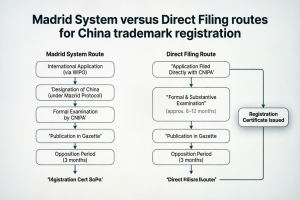
China joined the Madrid Protocol in 1989 and is one of the most frequently designated members. The process works as follows:
- File an International Application: Through your home country’s trademark office (Office of Origin), based on an existing national registration or application (the “Basic Mark”).
- Designate China: Include China (and any other member countries) in your designation list.
- WIPO Formal Examination: WIPO checks the application for formalities and forwards it to CNIPA.
- CNIPA Substantive Examination: CNIPA examines the mark under Chinese trademark law, independently of your home country’s examination.
- Publication and Registration: If approved, the mark is published for opposition and then registered.
Madrid vs. Direct National Filing: Key Differences
| Factor | Madrid Protocol | Direct CNIPA Filing |
|---|---|---|
| Cost | Lower for multiple countries; single application fee | Higher if filing in multiple countries separately |
| Timeline | 12-18 months (CNIPA has 12-18 months to examine) | 12-18 months (similar) |
| Dependency | Dependent on Basic Mark for 5 years (central attack risk) | Independent registration |
| Flexibility | Limited — cannot expand class scope after filing | Full flexibility — can file additional classes anytime |
| Assignment | Can only assign to entities in Madrid member countries | Can assign to any entity worldwide |
| Renewal | Single renewal through WIPO every 10 years | Separate renewal with CNIPA every 10 years |
Step-by-Step Madrid Filing for China
Step 1: Verify Eligibility
You must have a “Basic Mark” — either a registered trademark or a pending application — in your home country. The Basic Mark must cover the same mark and the same or narrower list of goods/services as your international application.
Step 2: Prepare the MM2 Form
Complete WIPO’s MM2 application form with:
- Applicant details (must match Basic Mark owner)
- Mark representation (identical to Basic Mark)
- Goods/services list (within the scope of Basic Mark)
- Designated countries including China (Code: CN)
Step 3: File Through Your Office of Origin
Submit the MM2 form to your home trademark office. They certify the application and forward it to WIPO. Processing time varies by country (typically 2-3 months).
Step 4: WIPO Review and CNIPA Notification
WIPO conducts a formal examination and publishes the international registration. CNIPA is notified and begins its independent examination under Chinese law.
Step 5: CNIPA Examination
CNIPA examines the mark for:
- Absolute grounds: Distinctiveness, descriptiveness, deceptive nature
- Relative grounds: Conflict with prior Chinese registrations
- Class compliance: Chinese subclass system requirements
If CNIPA issues a provisional refusal, you have a limited time to respond. Responses must be filed through a Chinese trademark agent.
Step 6: Publication and Registration
If CNIPA approves the mark, it is published for a 3-month opposition period. If no opposition is filed, the mark is registered with protection equivalent to a direct national registration.
Common Pitfalls and How to Avoid Them
Pitfall 1: Central Attack
If your Basic Mark is cancelled or invalidated within 5 years of the international registration date, your China designation collapses with it. This is the “central attack” risk. Mitigation: Ensure your Basic Mark is strong and actively used.
Pitfall 2: Subclass Mismatch
China uses a detailed subclass system within each Nice class. Your goods/services description must align with Chinese subclass requirements. Vague descriptions like “all goods in Class 25” are not accepted. Mitigation: Work with a Chinese trademark agent to draft compliant specifications.
Pitfall 3: Chinese Character Requirements
If your mark is in a non-Latin script, CNIPA requires a Chinese transliteration. This is not always captured in the Madrid filing. Mitigation: Include Chinese character versions in your application or plan for a separate Chinese-language filing.
Pitfall 4: Time Limits for Refusal Responses
CNIPA gives a strict deadline (typically 30 days, extendable) for responding to provisional refusals. Missing this deadline results in abandonment of the China designation. Mitigation: Monitor WIPO’s Madrid Monitor system and engage a Chinese agent immediately upon receiving a refusal.
Cost Comparison: Madrid vs. Direct Filing
For a single-country designation to China:
- Madrid Protocol: WIPO fee (CHF 300 for black-and-white mark) + CNIPA designation fee (varies by country) + Chinese agent fee for responding to office actions
- Direct Filing: CNIPA official fee (RMB 270-300 per class) + Chinese agent fee
For multi-country strategies, Madrid typically offers significant cost savings. For China-only protection, direct filing is often more cost-effective and provides greater flexibility.
Get Professional Assistance
Navigating Madrid Protocol designations to China requires expertise in both international trademark law and CNIPA examination practice. Our team can help you evaluate whether Madrid or direct filing is right for your situation, draft compliant specifications, and handle any CNIPA office actions. Contact us for a free consultation.