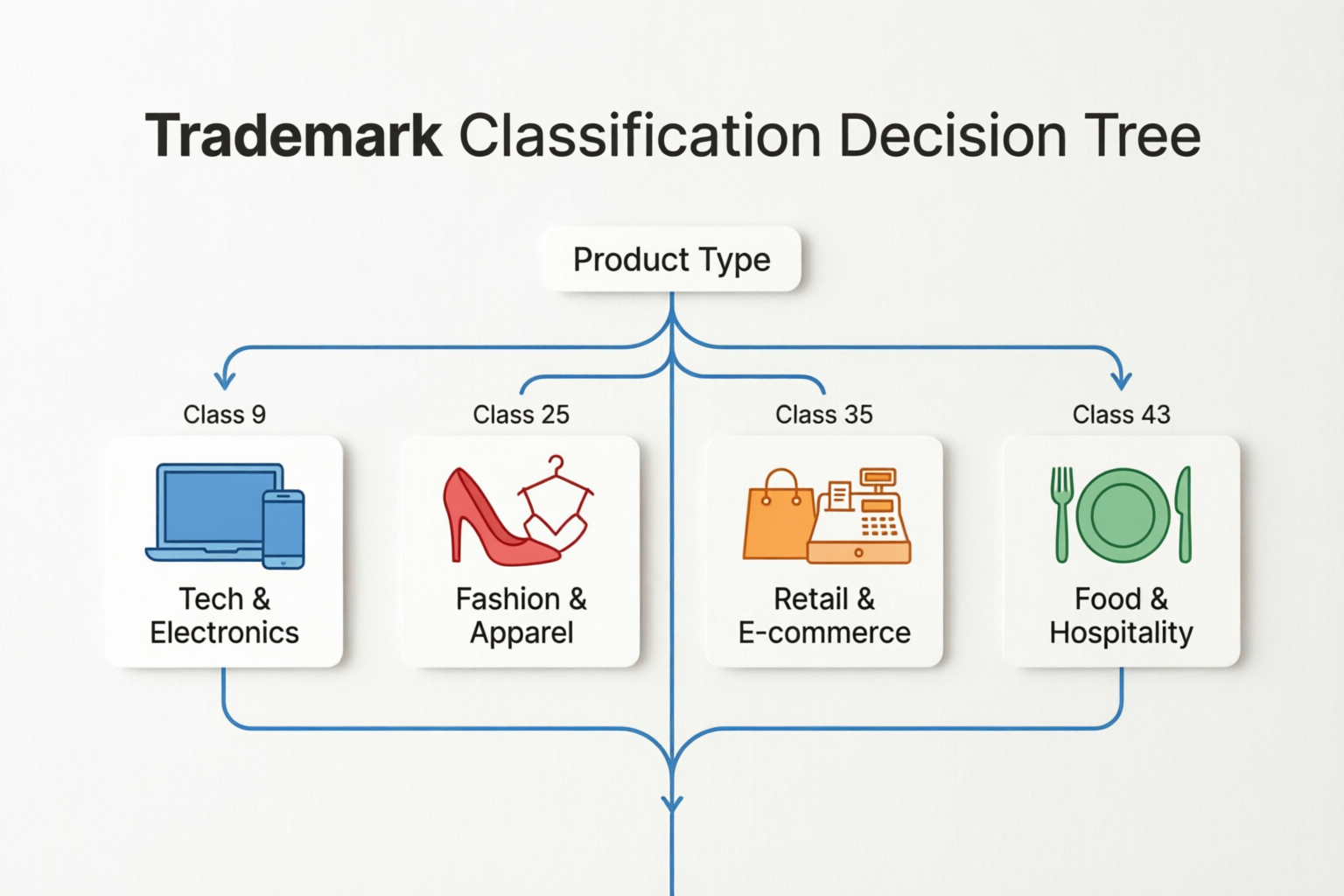
Choosing the right trademark class is arguably the most important strategic decision in your China trademark application. Pick too narrow and your brand is exposed; pick too broad and you risk unnecessary fees and refusals. Follow this 4-step guide to make the right choice.
Step 1: Identify Your Core Business Activities
Start with what you actually do—not what the Nice Classification says. List your:
- Products: What do you manufacture, sell, or distribute?
- Services: What services do you provide to customers?
- Business model: Retail, wholesale, online, franchise, licensing?
- Future plans for China: What might you do in the next 3–5 years?
Example: A clothing brand that sells online and plans to open retail stores needs classes 25 (clothing), 35 (retail/advertising), and potentially 42 (e-commerce platform).
Step 2: Map Activities to Nice Classes
Use the 45-class Nice Classification system adopted by CNIPA:
- Classes 1–34: Goods (products)
- Classes 35–45: Services
Common mapping pitfalls for foreign applicants:
- Selling online ≠ Class 35 alone: You also need classes covering your actual products
- Software products ≠ Class 42 alone: Downloadable software is Class 9; SaaS services are Class 42
- Restaurant ≠ Class 43 alone: If you sell branded food products, you need Class 29 or 30 too
Step 3: Add Defensive Classes
Beyond your core classes, consider these commonly-overlooked defensive registrations:
- Class 35: Retail, advertising, business management—critical for any consumer brand
- Class 9: If your brand could appear on an app, download, or digital product
- Class 16: Printed materials, packaging, stationery bearing your brand
- Class 41: Education, entertainment, events—important if you host brand events
Class Selection Examples by Industry
| Business Type | Core Classes | Recommended Defensive Classes |
|---|---|---|
| Clothing and fashion brand | 25 (apparel) | 35 (retail), 9 (app), 16 (packaging) |
| Software and app developer | 9 (software), 42 (SaaS/tech services) | 35 (advertising), 41 (training/events) |
| Restaurant and F&B chain | 43 (restaurant services), 30 (food) | 29 (prepared foods), 32 (beverages), 35 (retail) |
| Cosmetics and skincare | 3 (cosmetics) | 5 (medicated products), 35 (retail), 44 (beauty services) |
| E-commerce seller | Core product class(es) | 35 (online retail), 39 (logistics), 42 (platform services) |
Common Class Selection Mistakes
- Filing only Class 35 for an online business: Class 35 covers retail services, not your products themselves. Amazon and Tmall sellers still need the classes covering their physical goods.
- Ignoring the subclass system: CNIPA examines similarity at the subclass level. Two goods in the same class but different subclasses may still be considered similar under Chinese practice.
- Copying a US or EU filing: CNIPA’s acceptance rules and similarity groupings differ from the USPTO and EUIPO. A specification that works abroad may be rejected or be too narrow in China.
- Choosing vague descriptions: Terms such as “all other goods” are not accepted. Use CNIPA’s standard terms and be precise about each product.
- Forgetting future expansion: You cannot “add” classes to an existing registration later. Filing a new application means losing seniority, so think about your 3–5 year roadmap now.
Step 4: Verify CNIPA Subclass Acceptance
China uses a subclass system within each Nice class. Key points:
- CNIPA examines similarity across subclasses, not just within them
- Some goods in different subclasses are considered similar under Chinese practice
- Work with an experienced agent who understands CNIPA’s internal cross-subclass similarity rules
- Describe your goods/services precisely—vague descriptions may be rejected
A Practical Rule of Thumb
As a general guideline, most brands should register their core product or service class, plus Class 35 and at least one defensive class. The incremental cost of an additional class (RMB 270 in official fees plus a modest agent fee) is far lower than the cost of discovering an unprotected gap after a dispute arises.
Related Articles
- Understanding the 45 Nice Classes for China Trademark Registration
- Class 35: Why Every Brand Should File Defensively in China
- China Trademark Multi-Class Application Strategy
- China Trademark Agent Fees Compared
Official Resources
Disclaimer: Class selection is a strategic legal decision. This guide provides general information but does not replace professional advice from a CNIPA-accredited agent familiar with your specific business and industry.