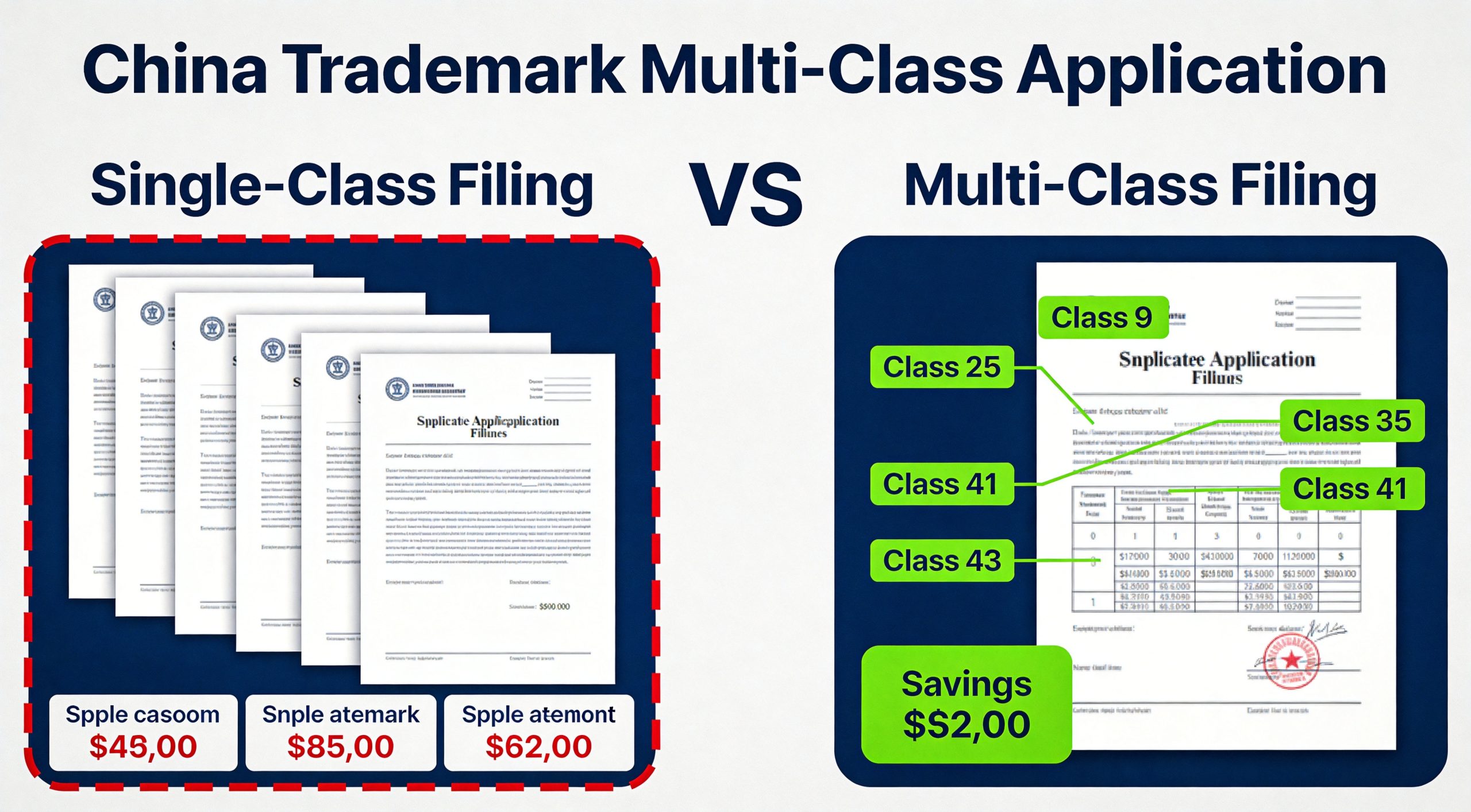
When filing a trademark in China, one of the most important strategic decisions is whether to file a single China trademark multi-class application or separate applications for each Nice Classification class. China allows both approaches, and the right choice depends on your brand strategy, budget, and risk tolerance. This guide explains the trade-offs and helps you decide.
How Multi-Class Filing Works in China
China adopted the “one application, multiple classes” system, which means you can designate multiple International (Nice) Classification classes in a single CNIPA application. For example, a fashion brand can file one application covering Class 25 (clothing), Class 35 (retail services), and Class 18 (leather goods) simultaneously.
Key features:
- One application form and one Power of Attorney covers all classes.
- Each class incurs a separate official CNIPA fee (RMB 270 electronic, per class).
- A single application number is assigned to all classes.
- The application is examined as a unified whole but each class is reviewed independently.
Advantages of Multi-Class Filing
Cost Savings on Agent Fees
The most significant advantage is reduced agent service fees. Filing three single-class applications incurs three separate agent fees (typically RMB 3,000-5,000 per class). A single multi-class application covering three classes typically costs 40-50% less in agent fees because:
- Only one Power of Attorney is prepared and notarized.
- One set of correspondence instead of three.
- Streamlined documentation and filing process.
Simplified Portfolio Management
A single application number for multiple classes makes tracking, renewals, and portfolio management significantly easier. You have one renewal date to remember instead of staggered deadlines across multiple filings.
Strategic Brand Positioning
Filing in multiple classes demonstrates a stronger commercial presence and broader brand protection intent. This can be advantageous when asserting rights and in opposition proceedings.
Disadvantages and Risks
Refusal in One Class Affects All
This is the primary risk. If CNIPA issues a provisional refusal for even one class (e.g., based on a conflicting prior mark), the entire application—including classes with no issues—may be delayed pending resolution. In the worst case, a final refusal in one class can complicate the registration of the others.
Slower Overall Processing
Multi-class applications may take slightly longer to process because examiners must review goods and services across multiple classes. If one class raises complex issues, the entire application waits.
Less Flexibility for Assignment
If you later wish to sell, license, or assign individual classes to different entities, splitting a multi-class registration requires a formal division procedure with CNIPA, which takes additional time and incurs fees.
Multi-Class Filing: Pros, Cons, and Costs at a Glance
A key benefit of multi-class filing is a single filing date across all classes, which matters in China’s first-to-file system — one day can decide priority. The main trade-offs are granular: China’s subclass system is more detailed than the Nice classes, so each class needs careful specification drafting, and splitting or assigning individual classes later requires a formal division procedure.
On cost, our all-inclusive filing is $275 per class, CNIPA official fee included, whether you file one class or several. For the underlying government charges, check the current CNIPA official fee schedule. If different subsidiaries will own different classes, or you plan to license classes separately, separate single-class filings may be simpler to manage despite the extra paperwork.
When to Choose Multi-Class vs. Single-Class
| Scenario | Recommended Approach |
|---|---|
| New brand entering China with core + defensive classes | Multi-class for core classes together; separate for high-risk classes |
| Distinctive, invented word mark with strong registrability | Multi-class filing is generally safe and cost-effective |
| Descriptive or weak mark likely to face objections | Single-class filings to avoid cross-class contamination |
| Pharmaceutical or regulated industry with strict classification | Single-class filings for precise control |
| Fashion brand covering apparel, accessories, and retail | Multi-class for related classes (25, 18, 35) |
| Technology company with broad IP portfolio | Mixed approach: multi-class for core tech classes, separate for ancillary |
Cost Comparison: Multi-Class vs. Single-Class
For a hypothetical 3-class trademark application (Classes 9, 35, 42) by a foreign applicant:
| Cost Item | 3 Single-Class Apps | 1 Multi-Class App |
|---|---|---|
| CNIPA official fees | RMB 270 × 3 = 810 | RMB 270 × 3 = 810 |
| Agent filing fees | RMB 3,500 × 3 = 10,500 | RMB 6,500 (bundled) |
| POA notarization | RMB 800 × 3 = 2,400 | RMB 800 |
| Translation | RMB 500 × 3 = 1,500 | RMB 800 |
| TOTAL | RMB 15,210 | RMB 8,910 |
| Savings with multi-class: | RMB 6,300 (41%) | |
Best Practices for Multi-Class Filing
- Conduct a thorough pre-filing search for all intended classes. Identify potential conflicts before filing so you can adjust your strategy.
- Group related classes together. File high-risk classes separately from low-risk ones to avoid cross-contamination.
- Ensure goods/services descriptions are precise. Vague descriptions increase the chance of office actions, which delay the entire multi-class application.
- Work with an experienced CNIPA agent. A knowledgeable agent can advise on classification strategy and anticipated examination trends.
Related Articles
- Understanding the 45 Nice Classes for China Trademark Registration
- China Trademark Registration Cost: Complete 2026 Fee Breakdown
- Complete Guide to China Trademark Registration Process
- Class 35: Why Every Brand Should File Defensively in China
Official Resources
Disclaimer: This article provides general information on China trademark filing strategy as of August 2026. Individual circumstances vary. Consult a qualified China trademark attorney for advice specific to your brand and industry.